Small teams collect a surprising amount of personal data when they hire. Every resume carries a name, contact details, a work history and often much more. It arrives by email, gets saved to a laptop, forwarded to a colleague, attached to a calendar invite and pasted into a chat. Months later, nobody knows how many copies exist.
This guide is a practical starting point. It is not legal advice, and the rules differ by country and state. If you hire in several jurisdictions or in a regulated sector, talk to a lawyer.
You are responsible for what you collect
When a candidate sends you their resume, your organization decides what to do with it. In the language of the EU and UK GDPR, that makes you the controller. A tool you use to store and review resumes acts on your instructions as a processor. California's privacy law uses similar ideas: a business, and its service providers.
The practical consequence is that choosing a tool does not hand off the responsibility. You still decide what is collected, who sees it, and when it is deleted. A good tool makes those decisions easy to carry out.
Tell candidates what happens to their information
Most privacy laws require people to be told how their information is used. Under the GDPR this applies even when you did not get the data from the person directly, for example a resume sent by a recruiter (Article 14). A short notice covers it:
- who is holding their information, and how to contact you;
- that it is used to assess them for the role, and by whom;
- how long you keep it, and what happens if they are not hired;
- how they can ask for a copy, a correction or deletion.
Put it in your job posting, your application acknowledgement or your careers page. Agencies should explain to candidates which clients will see their resume before sending it.
Keep it only as long as you need it
"Storage limitation" is one of the GDPR's core principles: personal data should be kept no longer than necessary for its purpose. Hiring has a natural end point: the role is filled. Decide a retention period and apply it consistently.
| Situation | A reasonable approach |
|---|---|
| Candidate not hired | Delete after a set period once the role closes. Six months is a common choice, long enough to respond to questions about the decision. |
| Candidate asks to be considered for future roles | Keep with their agreement, for a stated period, and ask again when it ends. |
| Candidate hired | Move what you need into employment records; delete the rest of the interview material. |
| Candidate asks for deletion | Delete promptly unless you have a legal reason to keep something, and tell them. |
Check local rules
Some jurisdictions require employers to keep certain hiring records for a minimum period, for example to answer discrimination complaints. Retention should satisfy both the minimum and the maximum that apply to you.
Limit who can see it
A resume should be visible to the people involved in the decision, and nobody else. The common leaks are ordinary ones: a shared folder with company-wide access, a link that works for anyone who has it, a resume forwarded to someone who left the panel.
- Give access per role, not per company.
- Require sign-in; avoid links that work without one.
- Remove access when someone leaves the panel.
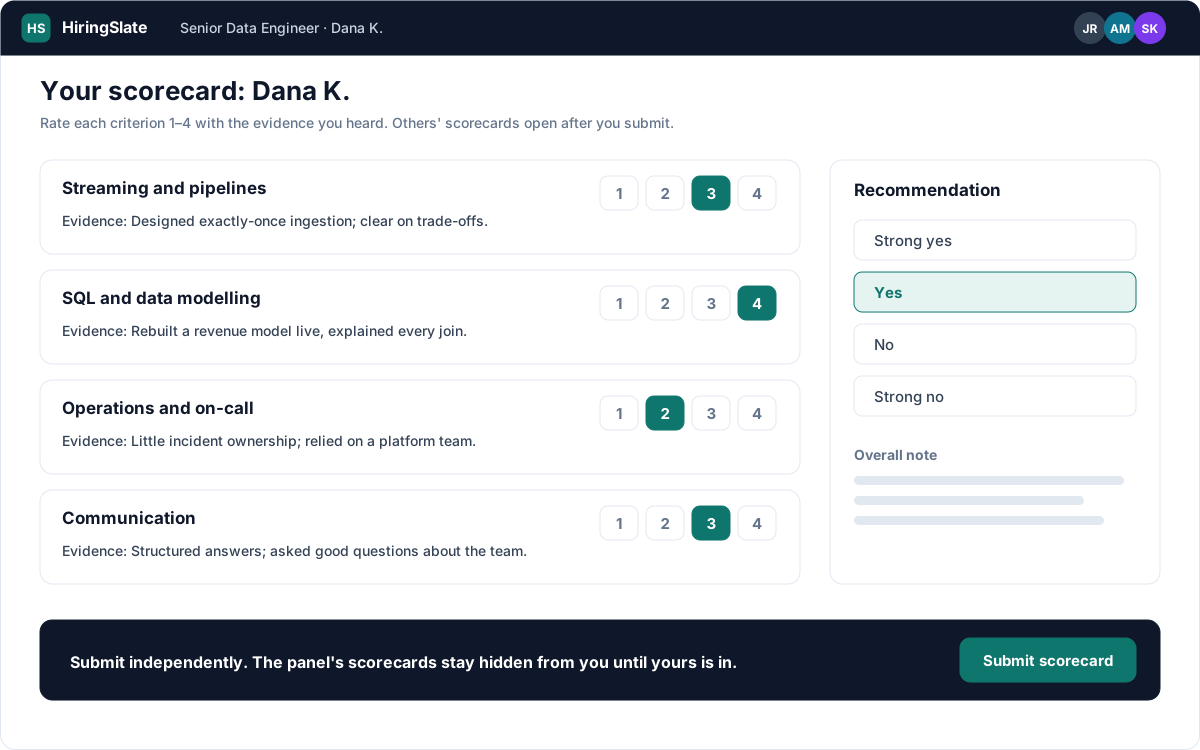
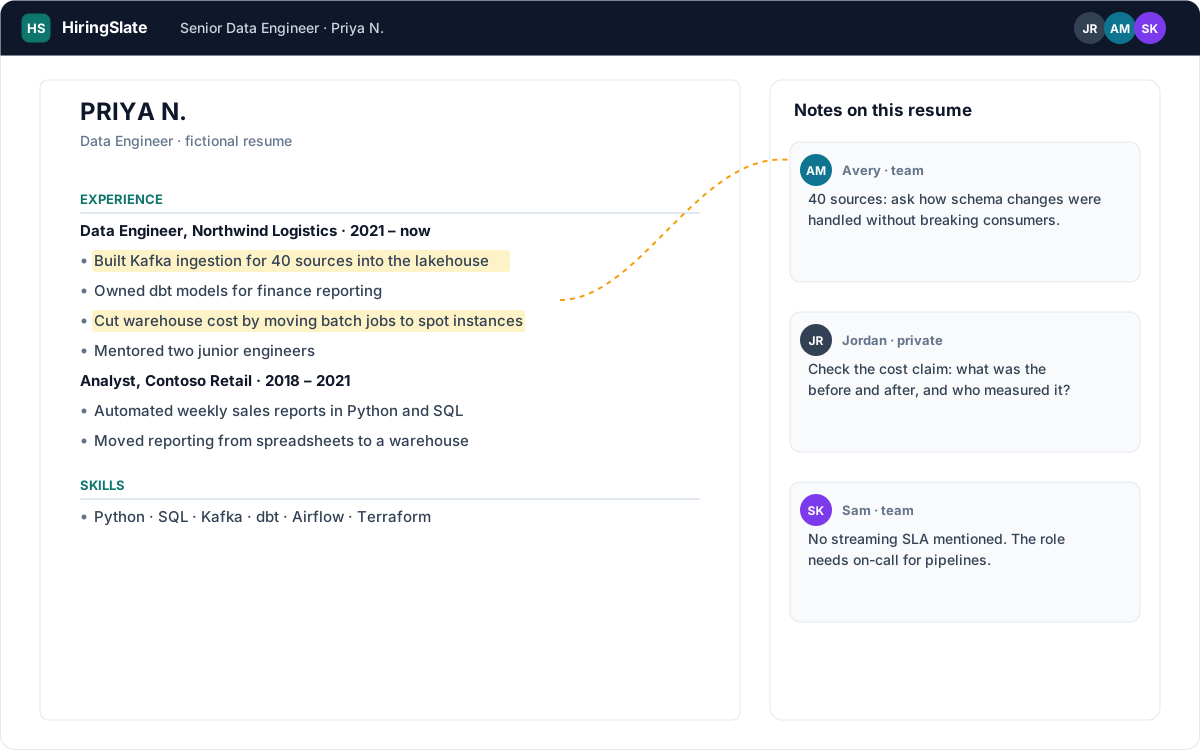
- Keep private notes private until they are needed.
Be careful what you write down
Interview notes and scorecards are personal data too, and candidates in many places can ask to see them. Write as if they will. Record evidence about the work, not impressions about the person, and never record protected characteristics such as age, religion, health or family situation.
How HiringSlate is set up for this
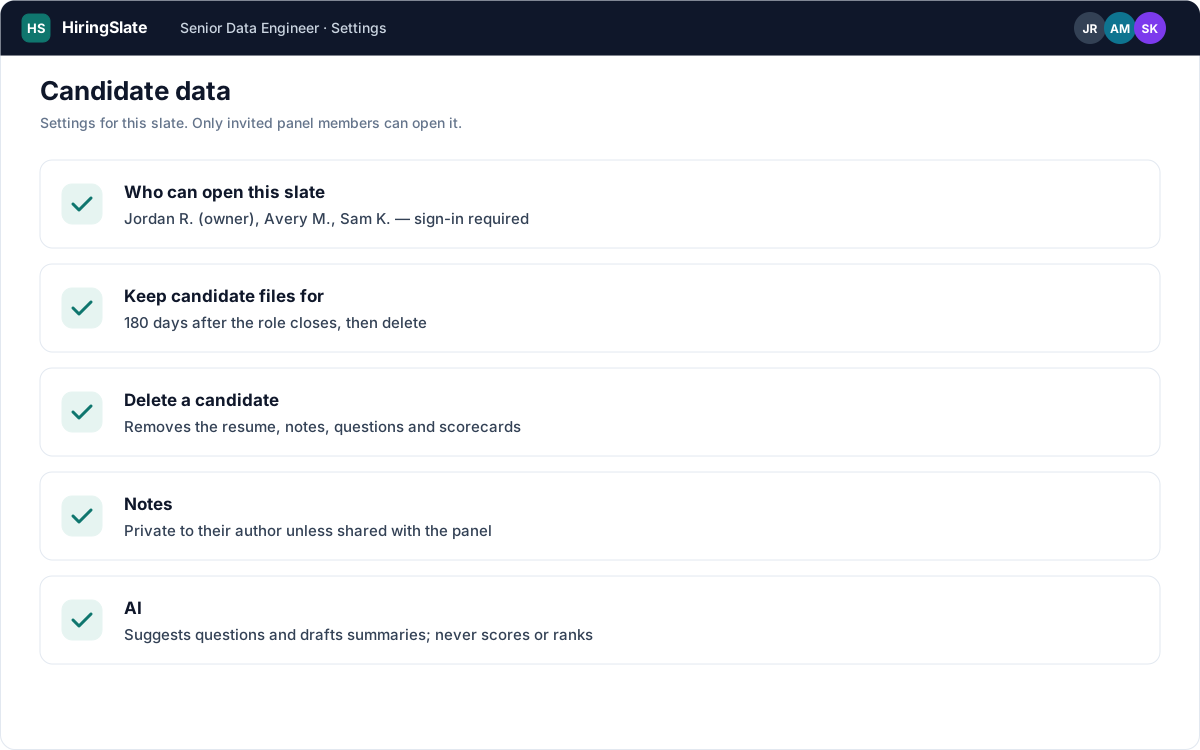
We built HiringSlate around these rules. Each slate is open only to the people invited to it, after they sign in. Notes are private to their author unless shared. Each slate has its own retention period, counted from when the role closes, and deleting a candidate removes their resume, notes, questions and scorecards together. Candidates' information is never used to train AI models.
A checklist for your next hire
- A short privacy notice in your posting or acknowledgement email.
- Resumes stored in one place, not in inboxes and chat threads.
- Access limited to the people on the panel.
- A retention period decided before the first resume arrives.
- A way to find and delete everything about one candidate.
- Notes and scorecards about the work, never about protected characteristics.
A resume is shared for one decision. Keep it to the people making that decision, for as long as it takes.
Run your next hire on one slate
Create a slate for the role, invite your panel and add the first resume. Free during early access.
Start a slate