Generic interview questions are easy to prepare and hard to learn from. "Tell me about yourself" and "what is your greatest weakness" have well-rehearsed answers, and they say little about whether someone can do this particular job.
Better questions come from comparing two documents: what the job needs and what the resume shows. Where they overlap, you go deeper. Where they don't, you ask. This post is about the second kind, the gaps, because they are where an interview earns its time.
Three kinds of gap
| Gap | Looks like | Question shape |
|---|---|---|
| A missing requirement | The job needs on-call operations; the resume never mentions incidents | "Tell me about the last time something you built broke in production." |
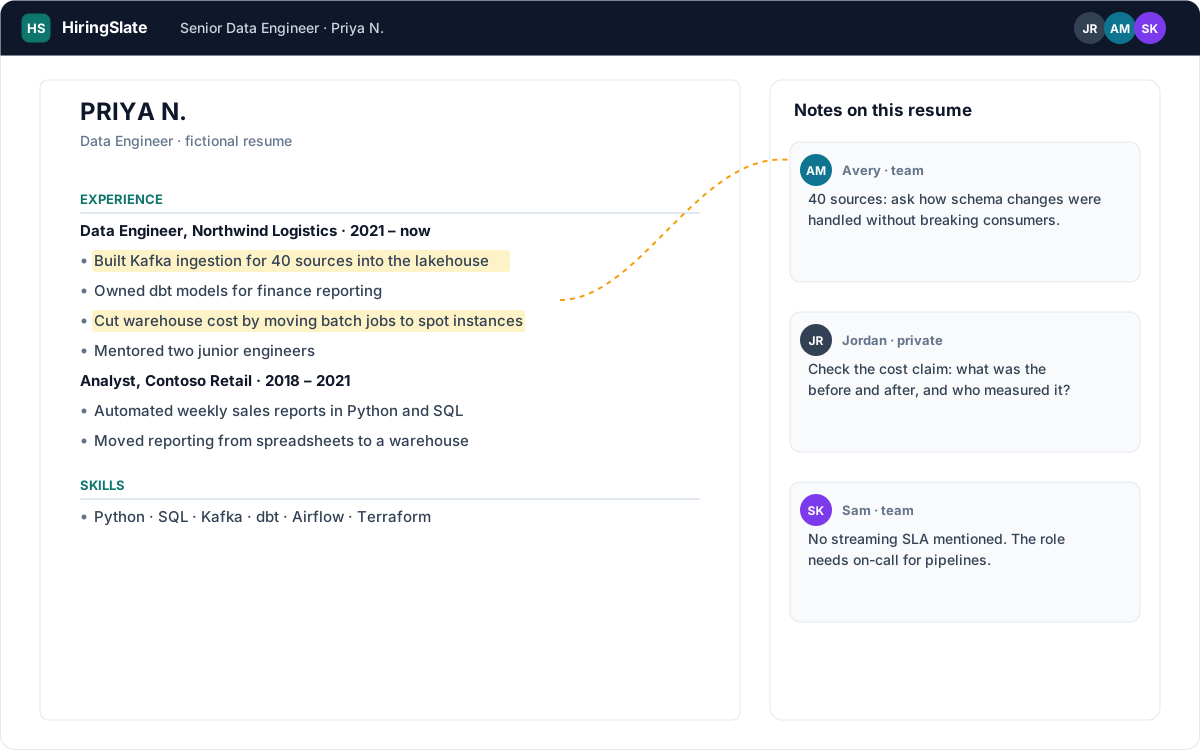
| A claim without context | "Reduced cost by 40%" with no baseline or method | "Walk me through how that was measured, and what your part was." |
| A difference in scale or setting | Built pipelines for a small team; the role is a large platform | "What would you expect to change in your approach at ten times the volume?" |
Gaps in dates are a fourth kind, and need care. A period between jobs is often caring for family, illness, study, a layoff or a move. Ask about it only if it bears on the role, ask neutrally, and accept a short answer. Many good candidates have them.
Turning a gap into a good question
A useful question about a gap has four properties:
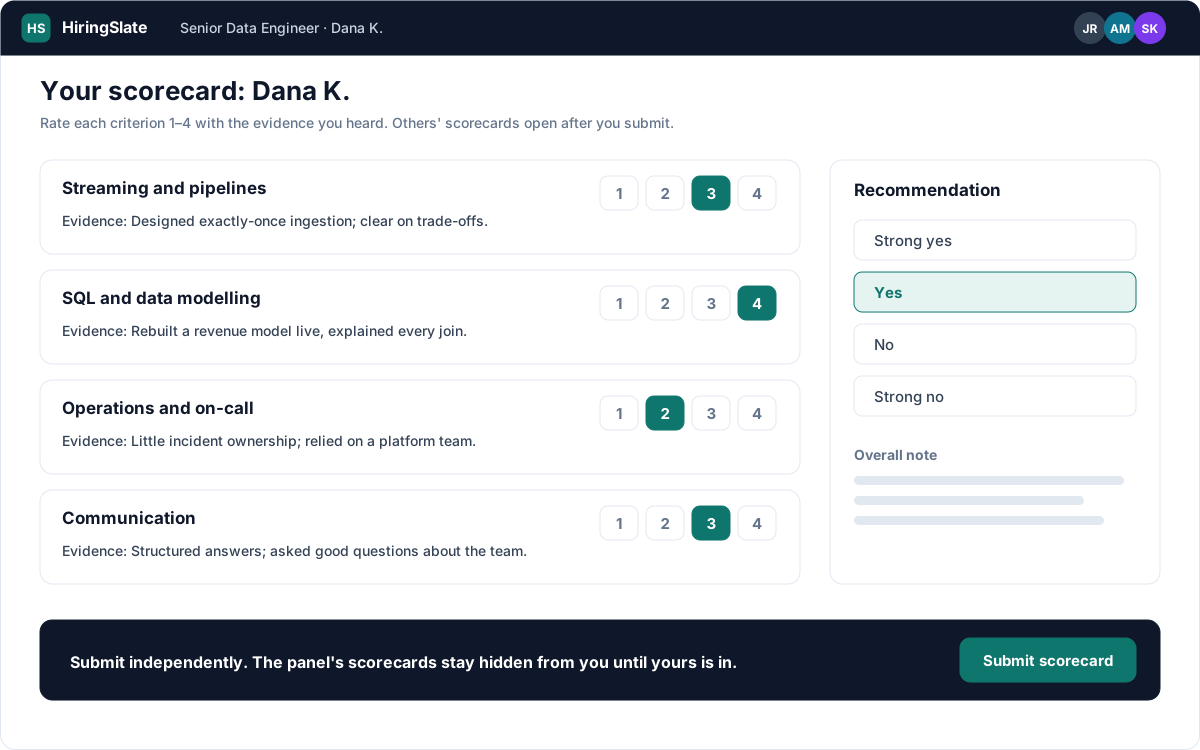
- Tied to a requirement. You can say which criterion the answer informs.
- Behavioural or situational. It asks what the person did, or would do, in a concrete situation.
- Open. It cannot be answered yes or no.
- Answerable without the resume item. A candidate without direct experience can still show how they think.
Have you done on-call?
Tell me about a time something you were responsible for failed in production. What happened, and what did you do in the first hour?
Is the 40% figure real?
How was the cost reduction measured? What was the spend before and after, and which part of the change did you build?
Follow-ups are where the evidence is
The first answer to any question is the prepared one. The follow-ups show depth: what did you decide not to do? what would you change now? who else was involved, and what was your part? Plan one or two follow-ups for each gap question so you are not improvising them on the call.
Questions to avoid
Not about personal characteristics
Questions about age, family plans, religion, national origin, health or disability, and similar topics are off limits in most jurisdictions, whatever the intent. If a gap might relate to one of them, ask only about the work: "Is there anything about the schedule for this role you'd want to discuss?" rather than anything personal.
- Brain-teasers and trick questions, which test familiarity with puzzles rather than the job.
- Hypotheticals so far from the role that any answer is unfalsifiable.
- Questions you would not ask every candidate for the same role, which break the comparability that makes structured interviews work.
Where AI suggestions help, and where they stop
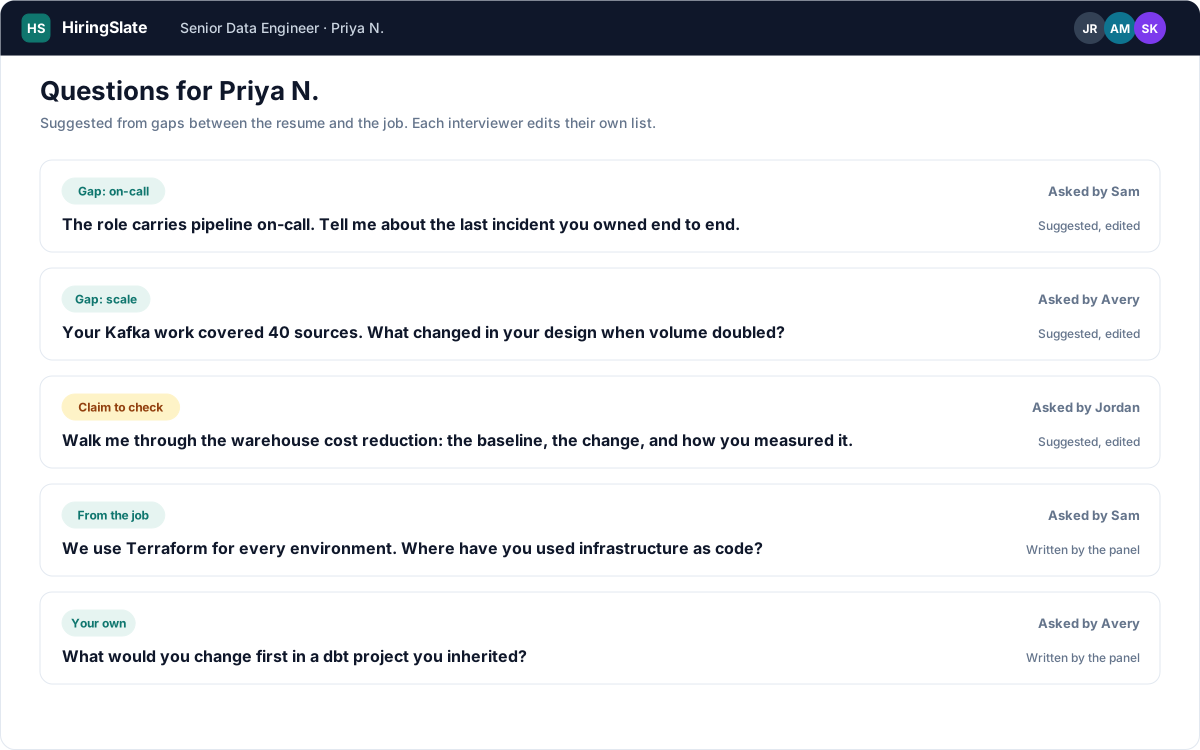
Finding gaps is mechanical work: list the job's requirements, check each against the resume, note what is missing or unsupported. Software can do that first pass quickly. In HiringSlate, comparing a resume with the job description produces suggested questions, each labelled with the gap or claim it comes from.
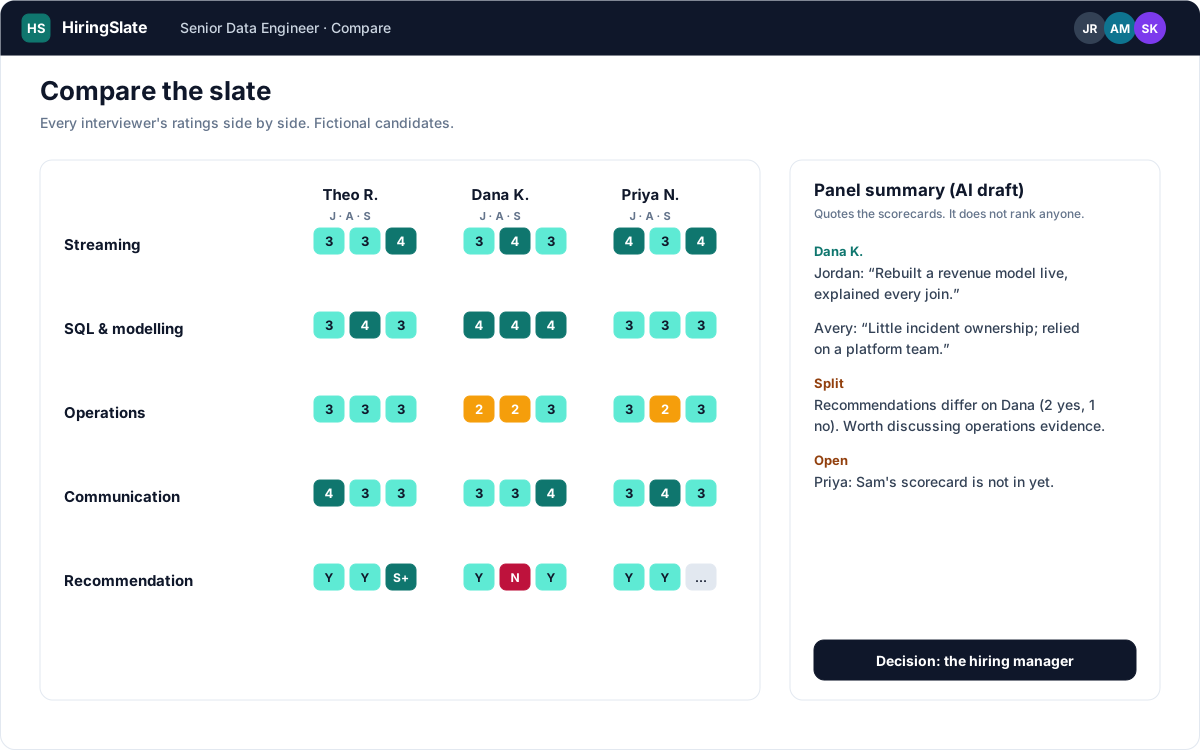
The suggestions are a starting point, not a script. The interviewer decides which matter, rewrites them in their own words, and adds questions the software could not know to ask. The software does not judge the candidate, and its suggestions never become a score.
Share the plan with the panel
If three interviewers each find the same gap, the candidate answers the same question three times and the panel learns nothing new. Agree who covers which gap before the interviews start, and leave room for each person's own questions.
Ask where the resume and the job don't meet. That is where the interview learns something the paper couldn't tell you.
Run your next hire on one slate
Create a slate for the role, invite your panel and add the first resume. Free during early access.
Start a slate