The debrief is the most consequential meeting in a hiring process and often the least prepared. People arrive with impressions, someone opens with a verdict, and the conversation spends its time on whatever was said first. The candidate who interviewed well with the most senior person tends to do well; the specific concerns get lost.
A fair debrief is not slower. It is ordered differently. This is a thirty-minute agenda that works for a panel of three to five.
Before the meeting: scorecards are in
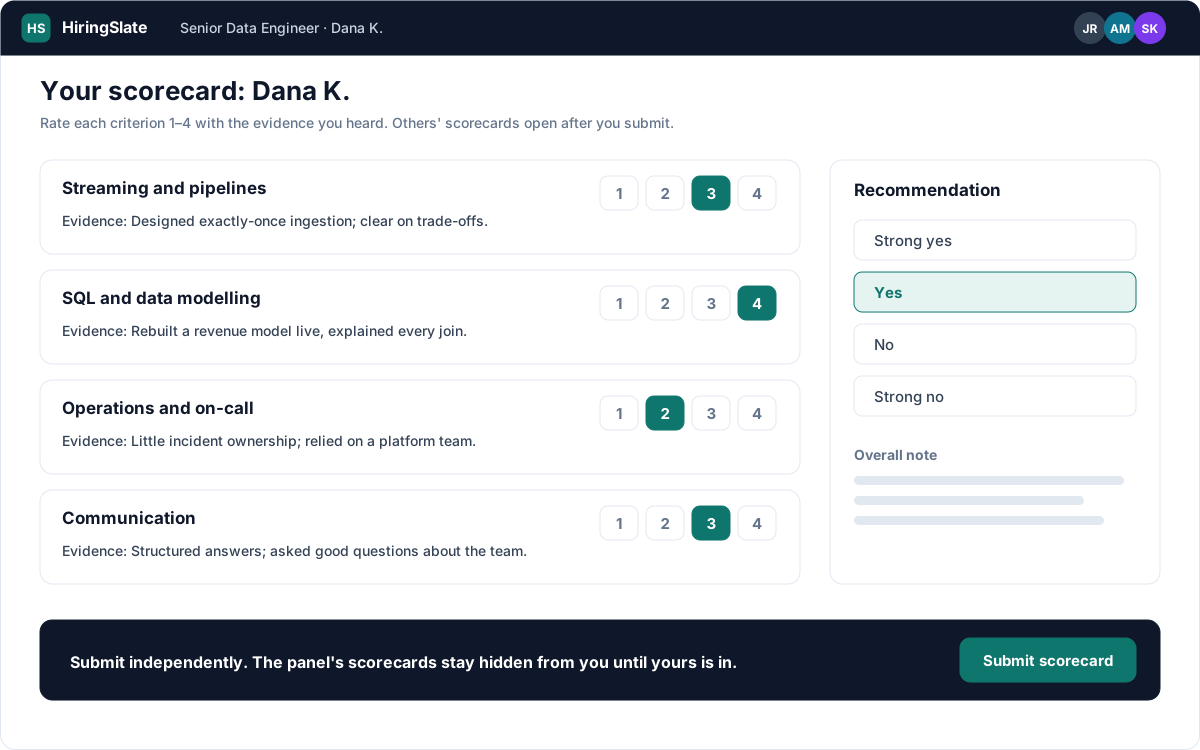
The single most important rule is that every interviewer has submitted a scorecard before the debrief begins, without seeing anyone else's. If someone has not, either wait or let them speak last and say so. A debrief where half the panel is still forming its view is a debrief that will follow the other half.
Why this matters
Hearing others' views before committing to your own pulls your judgement towards theirs. That is the basis of anchoring and conformity effects documented in decades of psychology research. Writing first is the cheapest protection there is.
A thirty-minute agenda
| Minutes | What happens | Who leads |
|---|---|---|
| 0 to 3 | Restate the role's criteria and the decision to be made | Facilitator (not the hiring manager) |
| 3 to 18 | Go criterion by criterion, starting with the biggest disagreement | Facilitator; interviewers give evidence |
| 18 to 25 | Gaps: criteria nobody found evidence for, and whether they matter | Panel |
| 25 to 30 | Recommendations, then the decision or the next step | Hiring manager speaks last |
Start with disagreement, not consensus
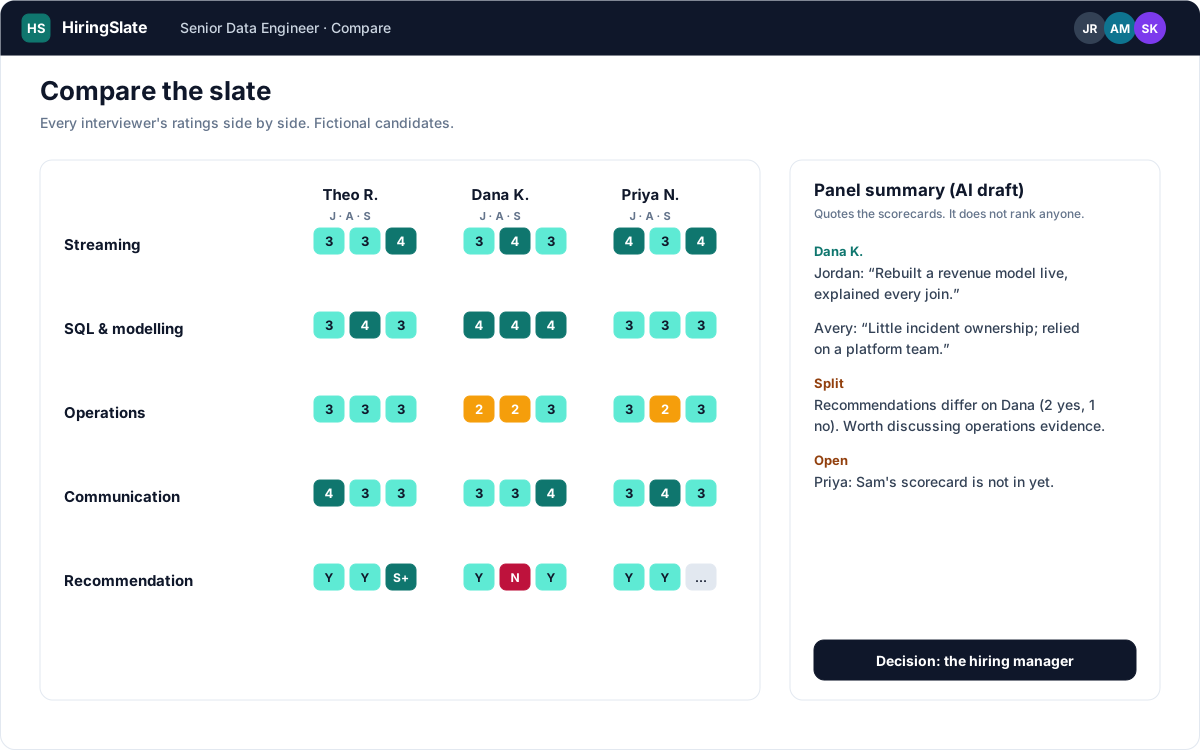
Where everyone rated a criterion the same, there is little to discuss. The useful time is where ratings differ, because that is where interviewers saw different things. Ask each person to describe the evidence behind their rating, not to defend the number.
Keep the evidence on screen
When the scorecards are side by side, nobody has to rely on memory or on the most confident voice. Each interviewer's rating stays visible rather than averaged into a single number, so a strong concern from one person is not hidden by two mild positives.
The hiring manager speaks last
The person with the most authority has the most influence on everyone else. If they open, the panel calibrates to them. If they close, they hear the evidence first and decide with it.
A summary that quotes, not one that judges
A written summary of the panel's feedback helps, especially when not everyone can attend. It should do two things: quote what interviewers actually wrote, and point out where they disagree. It should not add a verdict, an overall score or a ranking.
That is how HiringSlate's panel summary works. It is drafted by AI from the submitted scorecards, attributes every point to the interviewer who made it, and calls out splits and missing scorecards. It does not say who should be hired, because that is the panel's decision.
Things to steer away from
- Culture fit as a criterion. It often means similarity to the current team. If you mean specific behaviours, such as how someone handles disagreement, name and assess those.
- Comparisons to someone else. "Not as strong as the last person we hired" is not evidence about this candidate.
- Halo and horns. One great or poor answer colouring every criterion. Go criterion by criterion.
- Unrelated personal details. Anything about age, family, background or appearance has no place in the discussion or the notes.
After the meeting
- The decision, or the next step, is written down with the reason.
- Any follow-up has an owner and a date.
- Scorecards are not rewritten to match the outcome.
- The candidate hears back promptly, whatever the decision.
A good debrief combines separate observations. A bad one replaces them with the first opinion in the room.
Run your next hire on one slate
Create a slate for the role, invite your panel and add the first resume. Free during early access.
Start a slate